
Apolifina briefing
Watch the short explanation
What has changed
Vaping Products Duty came into force on 1 October 2026.
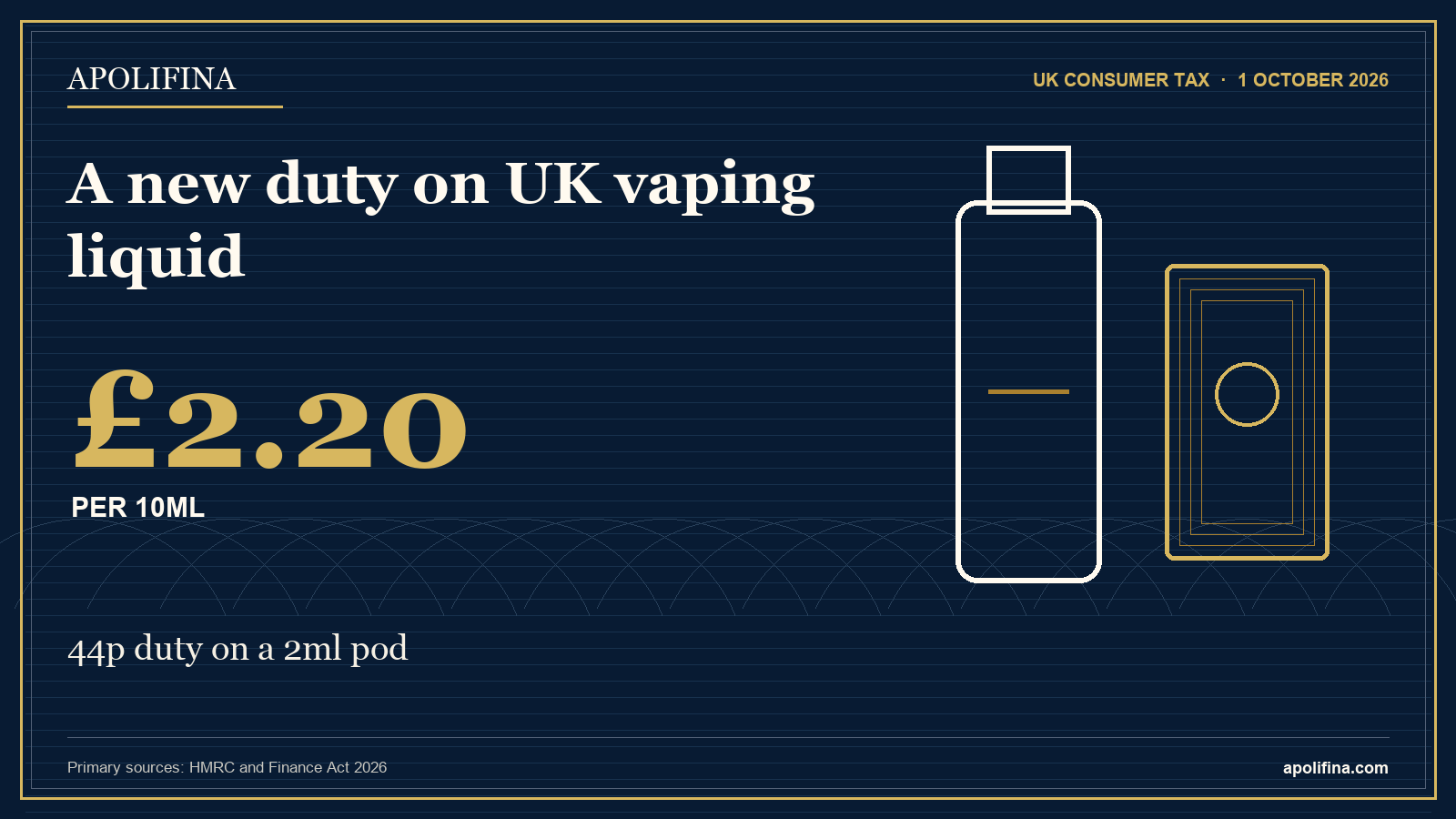
The flat rate is £2.20 for every 10ml of vaping liquid, equivalent to 22 pence per millilitre. It applies whether or not the liquid contains nicotine, provided it meets the legal definition of a vaping product.
That means a 2ml pod attracts 44 pence of duty, while a 10ml refill bottle attracts £2.20.
Manufacturers, importers and approved warehousekeepers are responsible for accounting for the duty. HMRC says it is a commercial decision whether businesses pass that cost to retailers and consumers.
How the stamp system works
New vaping products manufactured in or imported into the UK must carry a duty stamp.
Transitional stamps without digital features can be applied until 31 December 2026. Digital stamps become mandatory for newly manufactured or imported products from 1 January 2027.
Wholesalers and retailers have a six-month grace period for qualifying legacy stock. They can continue selling eligible unstamped products that were not liable for the new duty until 31 March 2027. From 1 April 2027, vaping products sold in the UK must carry a valid duty stamp.
What it could mean for prices
The tax adds £2.20 to the supply-chain cost of a standard 10ml bottle before considering VAT, retail margins or any other business costs.
That does not mean every bottle will immediately rise by exactly £2.20. Manufacturers, importers and retailers can decide how much of the cost to absorb or pass on. Existing stock may also delay the effect on some shop prices.
Competition, product size and retailer pricing strategies will determine the eventual consumer impact.
Changes for travellers
People arriving in Great Britain can bring up to 50ml of vaping liquid for personal use without paying duty and tax. Anyone bringing in more than 50ml must declare it and pay duty on the full quantity, not merely the amount above the allowance.
Different rules apply to travellers entering Northern Ireland, including distinctions between arrivals from EU and non-EU countries.
Tobacco duty also increased
Tobacco duty was increased on the same date. The government applied the existing tobacco-duty escalator, based on retail price inflation plus two percentage points, together with an additional one-off increase of £2.20 per 100 cigarettes or 50 grams of other tobacco.
The stated intention is to maintain a financial incentive for existing smokers to switch from tobacco to vaping, despite the new vaping duty.
What this means for investors
The measures affect vaping manufacturers, importers, wholesalers and retailers. They may influence prices, demand, margins, working capital and compliance costs.
Larger businesses may be better placed to absorb the administrative burden, while smaller operators could face proportionately higher costs. The stamp system may also support legitimate retailers if it reduces competition from illicit products.
These are possible commercial effects, not confirmed outcomes. The announcement does not identify individual listed-company winners or losers.
The Office for Budget Responsibility expects the duty to raise more than £550 million annually by 2030-31. Revenue will depend on consumption, compliance and the extent to which purchasing behaviour changes.
The Apolifina view
The direct tax calculation is simple, but the eventual market effect is not.
Consumers should distinguish the statutory duty from the final retail-price increase. Investors should watch company disclosures for evidence about pricing, volumes, margins and compliance costs rather than assuming the whole charge will be passed through uniformly.
The grace period also means the effect may appear gradually as older stock leaves the supply chain.
What remains uncertain
It is not yet clear how manufacturers and retailers will divide the cost, how quickly retail prices will respond or whether consumers will switch products.
The success of the stamp system will also depend on enforcement and consumers' ability to distinguish legitimate products from illicit stock.
Primary sources and verification
- HMRC: New Vaping Products Duty comes into effect
- HMRC: How to pay Vaping Products Duty
- HMRC: Goods liable to excise duty
- Finance Act 2026, sections 115 and 116
The rate, operative date, stamp timetable, legacy-stock period, traveller allowance and stated revenue forecast were checked against live HMRC and legislative sources.
Continue reading: UK inflation rises to 3.1% · UK retail sales rise 0.5% · Stocks and Shares ISAs explained