
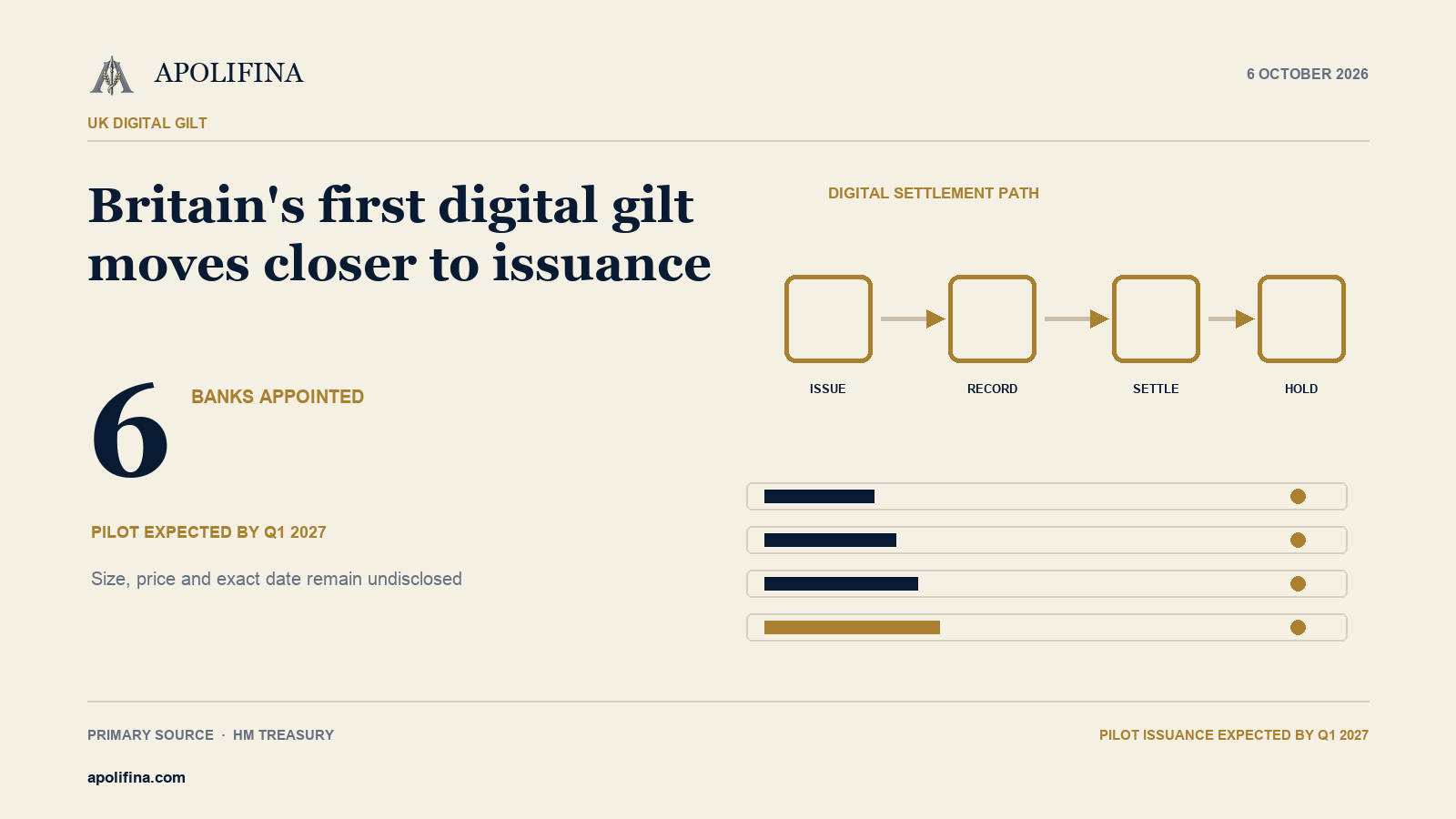
Six banks appointed to the pilot
The UK government has appointed six banks to manage the pilot issuance of Britain's first digitally native government bond.
Barclays, HSBC, Lloyds, Morgan Stanley, NatWest and RBC Capital Markets will act as joint lead managers for the Digital Gilt Instrument, known as DIGIT.
Their appointment completes the procurement process and allows investor engagement to begin. The banks will provide underwriting, distribution and other conventional bond-management services. HM Treasury expects the pilot issuance to take place by the first quarter of 2027.
What makes DIGIT different?
DIGIT will be a short-dated government bond issued and managed using distributed ledger technology. It is intended to support on-chain settlement, meaning ownership and settlement records can be handled through the underlying digital infrastructure rather than solely through conventional securities systems.
The bond will be issued on a platform operating inside the UK's Digital Securities Sandbox. A Treasury speech delivered alongside the announcement identifies this as HSBC's Orion platform.
The pilot will remain separate from the government's main debt-management programme. It is therefore an experiment in market infrastructure, rather than a replacement for conventional gilt issuance.
What has actually been decided?
The government has selected the institutions that will help arrange and distribute the bond. That is an important operational step, but DIGIT has not yet been issued.
The announcement does not disclose the amount the government intends to raise, the bond's exact maturity, coupon or expected yield, issue price, eligible investors or a precise issuance date. Those details will matter when assessing the transaction itself.
What this means for investors
A successful issuance could demonstrate that a sovereign bond can be created, distributed, settled and administered using regulated digital infrastructure. It could also encourage investment in compatible custody, settlement and trading systems.
However, the announcement does not create a new retail investment opportunity and should not be treated as direct exposure to cryptocurrency. The underlying instrument remains UK government debt. The experimental element concerns the technology used during its issuance and lifecycle.
The Apolifina view
DIGIT is significant primarily as a test of financial-market infrastructure. The involvement of six large banks shows that the pilot has progressed beyond an early technical proposal. It does not establish that digitally native bonds will be cheaper, more liquid or widely adopted.
The most useful evidence will come after issuance, particularly whether the digital system reduces operational friction and can interact efficiently with conventional market infrastructure.
What remains uncertain
The issuance size, maturity, eligible investor base, settlement arrangements and pricing have not yet been announced. Pilot outcomes and wider market adoption are also unknown.
Fragmented platforms could reduce rather than improve liquidity if interoperability remains limited. Investors should therefore focus on the eventual transaction details and results, rather than the technology label alone.
Primary sources and verification
- HM Treasury: UK takes next step towards first digitally native government bond
- HM Treasury: Economic Secretary speech for UK Digital Assets Week
The appointments, expected timing and pilot-design details were checked against Treasury material published on 6 October 2026.
Continue reading: UK borrowing exceeds the OBR forecast · FCA crypto authorisation gateway opens · How to choose an investment platform