
What businesses expect
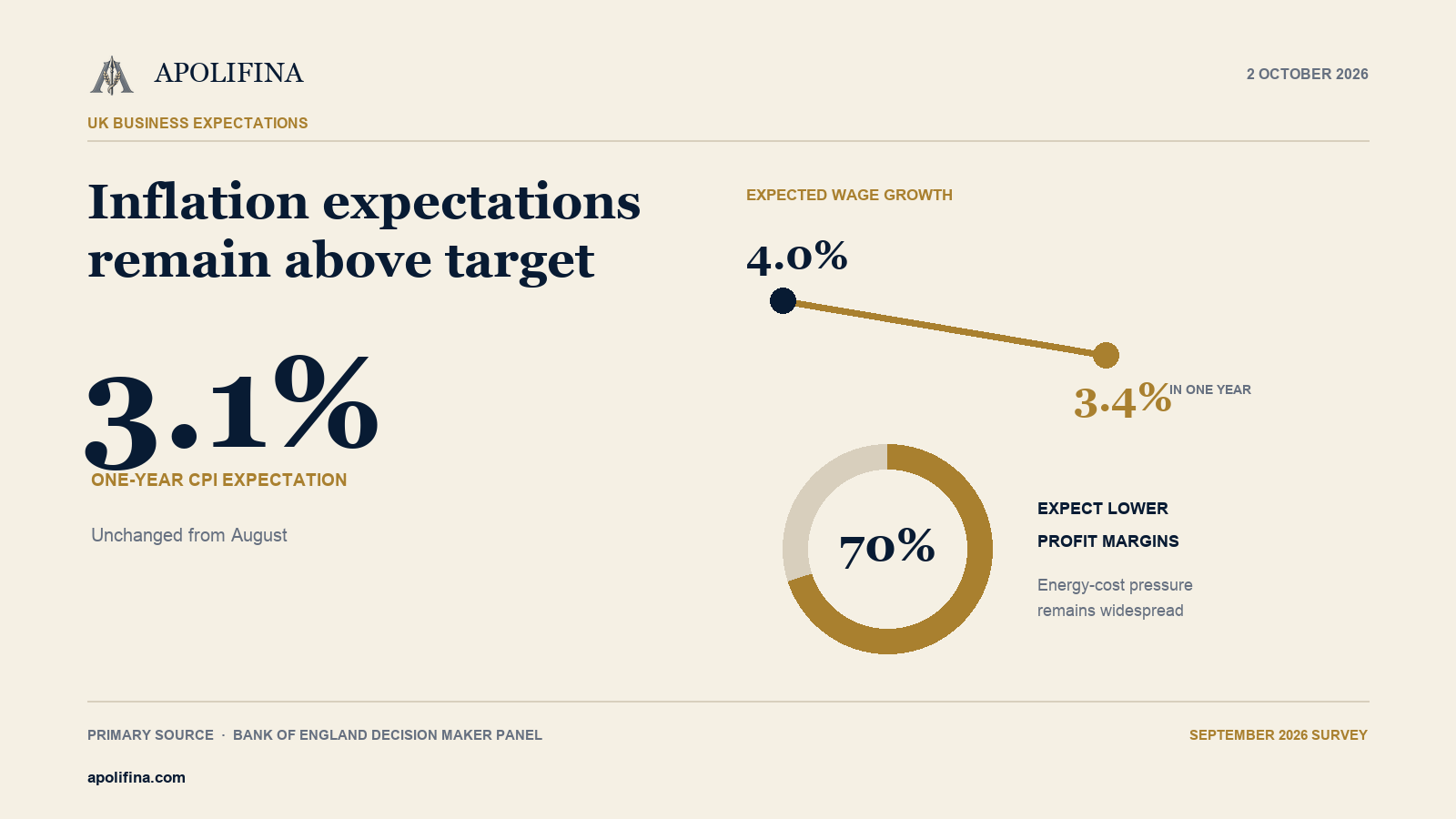
UK firms expected consumer price inflation of 3.1% in one year's time during the three months to September, unchanged from the equivalent measure in August.
Three-year CPI inflation expectations were also unchanged at 2.8%. Both measures remain above the Bank of England's 2% inflation target.
The Decision Maker Panel surveyed 1,993 chief financial officers between 4 and 18 September. Results are weighted to represent the UK business population.
Wage growth is expected to slow
Firms reported annual wage growth of 4.0% in the three months to September. They expected their wage growth to be 3.4% in a year's time, implying a slowdown of 0.6 percentage points.
Realised own-price growth was 3.7%, unchanged from the three months to August. Expected own-price growth over the next year was also 3.7%, down 0.1 percentage points from the previous survey measure.
Employment expectations improved slightly
Realised annual employment growth remained negative at minus 0.2%. Expected employment growth over the next year increased by 0.1 percentage points to positive 0.2%.
That is a small improvement, not evidence of a strong hiring rebound. Survey expectations can change as demand, costs and financing conditions evolve.
Energy costs are still squeezing margins
Fifty-seven per cent of firms expected the recent energy shock to lead them to increase prices over the following 12 months, down from 59% in August and 64% in April.
Seventy per cent expected lower profit margins, two percentage points more than in April. This suggests many businesses may absorb part of the shock rather than pass every cost increase to customers.
What this means for investors
Stable inflation expectations above target may reinforce the case for the Bank of England to move carefully on interest rates. The expected slowdown in wage growth points in the opposite direction by suggesting some easing in domestic cost pressure.
For companies, the margin result is important. Businesses that cannot pass higher input costs to customers may face weaker profitability even if headline revenue rises.
The survey spans the whole economy. It does not imply that every sector or listed company faces the same pricing power, wage pressure or employment outlook.
The Apolifina view
The survey is consistent with gradual cooling rather than a decisive end to inflation pressure.
Wage growth is expected to slow and fewer firms plan price increases than in April, but CPI expectations remain above target and margin pressure is widespread. Investors should compare these expectations with realised inflation, labour-market data and company results.
What remains uncertain
The panel records expectations, not guaranteed outcomes. Energy prices, demand, exchange rates, fiscal decisions and interest rates could change the picture before the next survey.
The Bank will publish the next monthly Decision Maker Panel data on 30 October 2026.
Primary source and verification
Inflation, wage, price, employment, energy and sample figures were checked against the Bank of England release published on 2 October 2026.
Explore the topic: UK inflation and interest rates
Continue reading: Bank Rate held at 3.75% · UK inflation rises to 3.1% · UK labour market softens